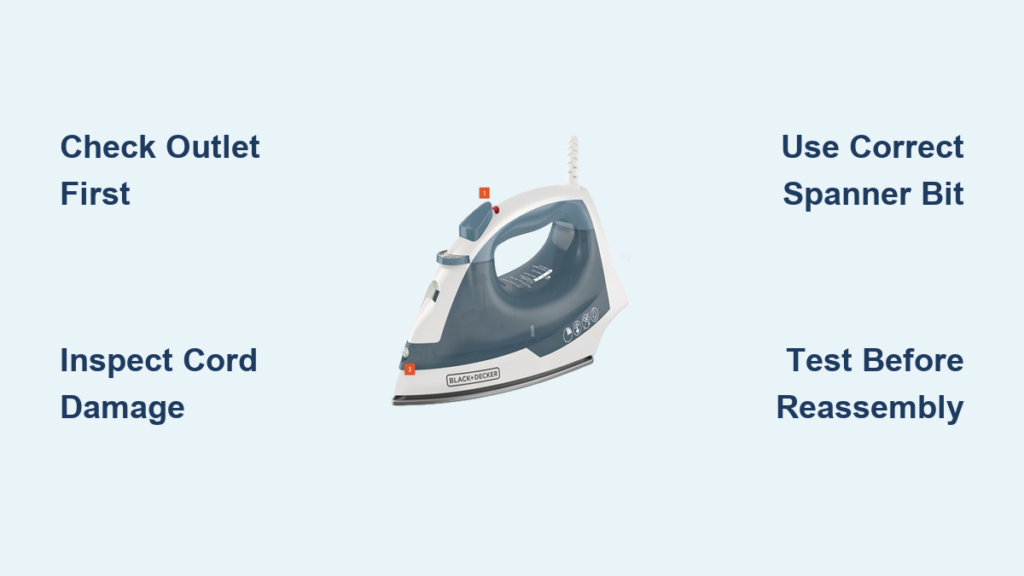
Nothing disrupts your morning routine like reaching for your Black and Decker steam iron only to find it won’t power on or keeps cutting out mid-ironing session. When your iron suddenly fails, you face an immediate decision: attempt Black and Decker steam iron repair or replace the entire unit. Before you toss your malfunctioning appliance, know that many common issues—especially cord-related problems in models like the D2030—can be fixed with basic tools and electrical knowledge. This guide cuts through the confusion to show you exactly when repair makes sense, which models are actually fixable, and how to safely restore your iron to working condition without creating fire hazards.
Why Your Black and Decker Iron Won’t Power On
Power failures represent the most common Black and Decker steam iron repair scenarios. Before diving into internal components, rule out simple external issues that could save you hours of unnecessary work.
Testing Your Electrical Outlet First
Don’t jump straight to disassembly—start by verifying your outlet works with another device. Plug in a lamp, phone charger, or small appliance to confirm power delivery. If the outlet functions properly, the problem lies within your iron itself. This simple step prevents wasted effort when the issue is as basic as a tripped circuit breaker or faulty wall socket. For irons showing no signs of life, this initial check eliminates the most common false diagnosis.
Identifying Cord-Related Power Failures
If your Black and Decker iron powers on only when you manipulate the cord base—turning on when moved left or up but cutting off when shifted right or down—you’re dealing with a classic cord failure. This intermittent behavior indicates a broken wire inside the cord assembly, typically at stress points where the cord enters the iron body or connects to the plug. The D2030 model frequently develops this specific symptom pattern due to wire breakage just centimeters inside the cord entry point.
Pro tip: When testing cord movement, note exactly which positions restore power—this helps pinpoint the failure location during repair. If wiggling the cord near the plug affects operation, the damage is at the plug end; if only base manipulation works, the break is inside the iron housing.
D2030 vs. D3300: Which Black and Decker Iron Can You Actually Repair?
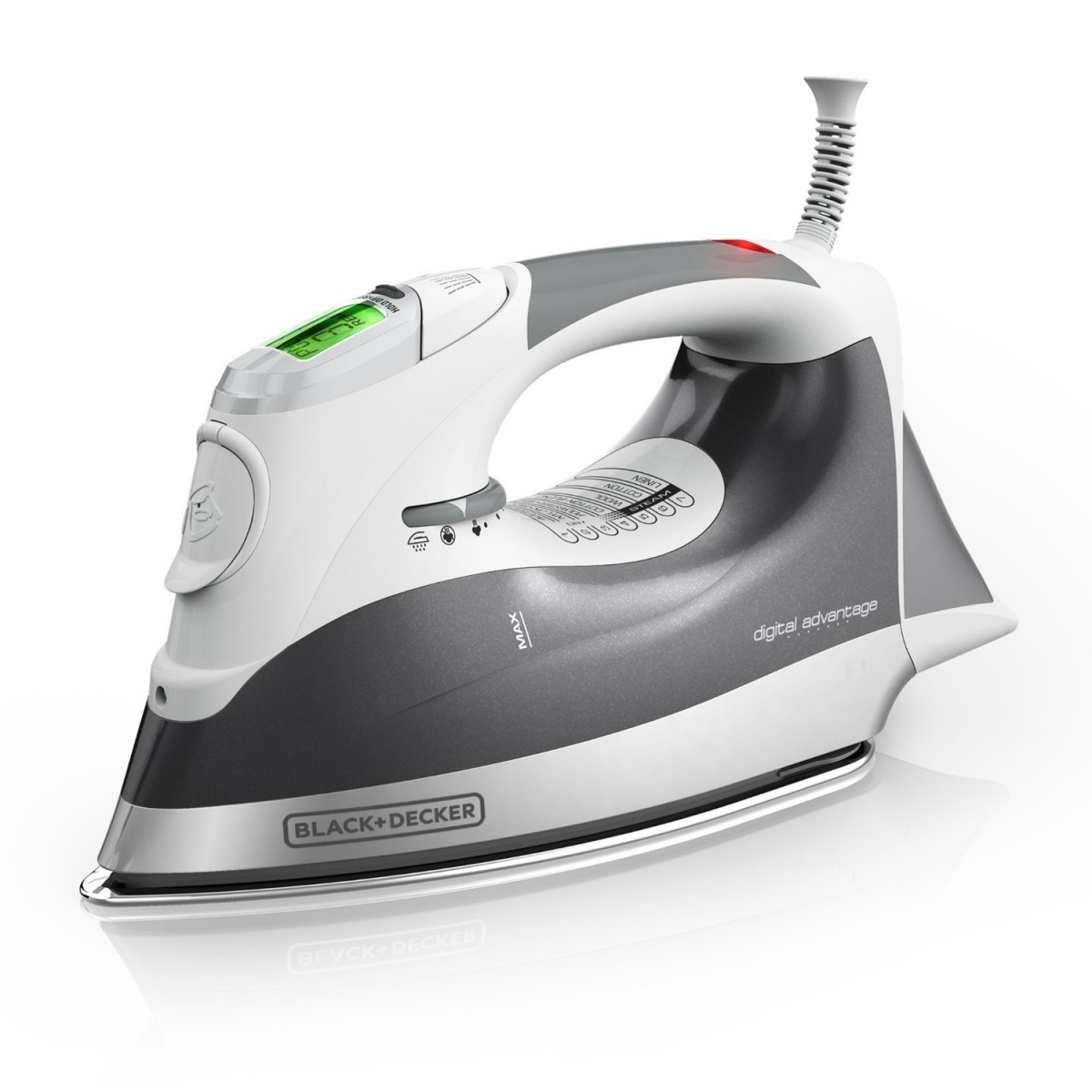
Your model number determines whether Black and Decker steam iron repair is possible or if you’re facing a disposable appliance.
D2030: User-Repairable Power Cord Design
The Black and Decker D2030 features accessible internal components that technically inclined users can service. Its power cord connects via wire nuts to internal wiring, allowing straightforward replacement when cord damage occurs near the entry point. This model uses standard 16-gauge wiring (marked on the cord itself), and replacement parts can be sourced from hardware stores. The documented repair process typically takes 1-2 hours for first-time technicians with the right tools.
D3300: The Disposable Iron Reality
In contrast, the Black and Decker D3300 represents modern “disposable appliance” design philosophy. Manufacturer documentation explicitly classifies this model as non-serviceable with no replacement parts available. When internal components fail in a D3300, your only options are warranty replacement (if within the 2-year coverage period) or complete disposal. Attempting DIY repairs on this model is futile since Black and Decker won’t supply internal components to consumers or independent repair shops.
Critical Safety Steps Before Black and Decker Iron Repair
Ignoring these safety protocols when attempting Black and Decker steam iron repair dramatically increases fire risk—irons cause more household fires than most appliances due to their combination of high heat and electrical components.
Essential Pre-Work Safety Checklist
- Always unplug and cool completely before starting—never work on a plugged-in or warm iron
- Drain all water from the reservoir to prevent internal spills during disassembly
- Use proper wire gauge—any replacement wiring must match the original 16-gauge specification (lower gauge number = thicker wire)
- Secure all connections—loose wires or exposed conductors create fire hazards
- Test at every stage—verify functionality after wire connection but before reassembly
Warning: Black and Decker intentionally designs many models as non-serviceable units using security fasteners. Improper repair can void remaining warranty coverage and create serious safety hazards. If you’re uncomfortable with basic electrical work, professional service remains the safer option despite potentially higher costs.
Tools You Need for Black and Decker D2030 Cord Replacement

Attempting Black and Decker steam iron repair without these specific tools leads to frustration and potential damage to your appliance.
Spanner Bit Screwdriver Set (Non-Negotiable)
BLACK+DECKER uses tamperproof spanner-head security screws—not standard Phillips heads—on the D2030 back panel. You’ll need the largest spanner bit from a set like the Klein 32510 Magnetic Screwdriver with 32-Piece Tamperproof Bit Set. These specialized bits are available separately if you already own a compatible screwdriver handle. Without the correct spanner bit, you’ll damage screw heads and complicate future repairs.
Essential Supporting Tools
- Wire strippers for preparing cord ends
- Needle-nose pliers for manipulating wire nuts
- Small flat-head screwdriver for prying covers
- Phillips screwdriver for internal components
- Pro tip: Photograph your wiring configuration before disconnecting anything—this visual reference prevents connection errors during reassembly
Step-by-Step D2030 Power Cord Replacement
Follow this precise sequence to safely replace your Black and Decker steam iron’s faulty cord without creating new problems.
Removing the Back Panel Safely
- Drain all water from the iron reservoir
- Attach the largest spanner bit to your screwdriver
- Remove both security screws from the back panel
- Gently pry the translucent cover using a flat-head screwdriver, working around edges to release clips
- Squeeze the handle section while pushing toward the base with thumb and index finger to remove the inner cover
Visual cue: Look for small white plastic clips securing the cover—apply pressure opposite their direction to release without breaking.
Cord Replacement Without Creating New Hazards
- Label all non-power wires (use “R” for right-side, “L” for left-side)
- Crush wire nuts along their long axis with needle-nose pliers to release connections
- Remove the Phillips screw securing the cord clamp
- Pull the cord assembly free through the large plastic ring
- Inspect for broken wires just inside the entry point (common failure location)
- Cut damaged section and strip 1cm of insulation from each wire end
- Tie a strain-relief knot in the cord at the same position as the original
- Match labeled wires and twist connections together before installing new wire nuts
Critical step: Test functionality after wire connection but before reassembly—plug in the iron and verify it powers on consistently even when wiggling the cord. This early testing prevents wasted reassembly time if connections are incorrect.
Should You Repair or Replace Your Black and Decker Iron?
Weigh these practical factors before investing time in Black and Decker steam iron repair.
Cost-Benefit Analysis by Model
| Model | Repair Cost | Replacement Cost | Repair Viability |
|---|---|---|---|
| D2030 | $5-15 (parts) + 1-2 hours | $30-60 | High – User-repairable |
| D3300 | Not applicable | $25-50 | None – No parts available |
For D2030 owners, repair becomes economical if you already own the spanner bit set (typically $30-50). New buyers should compare the $30-50 tool investment against the cost of a replacement iron. For D3300 owners beyond warranty period, replacement is always the only practical solution since no official parts exist.
Environmental Impact Consideration
Repairing your Black and Decker steam iron extends product lifespan and reduces electronic waste. For models like the D2030 where repair is feasible, the environmental benefit often outweighs the minor time investment—especially when you already own basic tools. However, don’t force repairs on disposable models like the D3300; newer energy-efficient replacements may offer better long-term environmental value.
Prevent Future Black and Decker Iron Failures
Extend your iron’s lifespan with these manufacturer-aligned maintenance practices that prevent common failure points.
Cord Care That Prevents Breakage
- Store with loose coils—never wrap tightly around the iron body
- Avoid sharp bends at stress points where cord meets iron
- Inspect regularly for crimps or irregularities near connection points
- Unplug by gripping the plug—never yank the cord
Expert note: The most common cord failure occurs where the cord enters the iron body due to repeated flexing during use. Proper storage and handling prevents 80% of cord-related Black and Decker steam iron repair needs.
Final Verdict: Is Black and Decker Steam Iron Repair Worth It?
For D2030 owners experiencing intermittent power issues, Black and Decker steam iron repair delivers excellent value if you have basic electrical skills and the required spanner bit set. The documented 1-2 hour repair process saves money while extending appliance life. However, newer models like the D3300 represent the disposable appliance trend—when they fail, replacement is your only realistic option since no parts exist for repair.
Most important consideration: Never compromise on safety for cost savings. If you’re unsure about electrical connections or wire gauge requirements, professional service through BLACK+DECKER’s authorized center locator provides peace of mind. For technically confident users, proper Black and Decker steam iron repair done correctly restores functionality safely while keeping functional appliances out of landfills. Before you replace, verify your model number and determine whether your specific iron belongs to the repairable or disposable category—this single step determines your entire repair pathway.