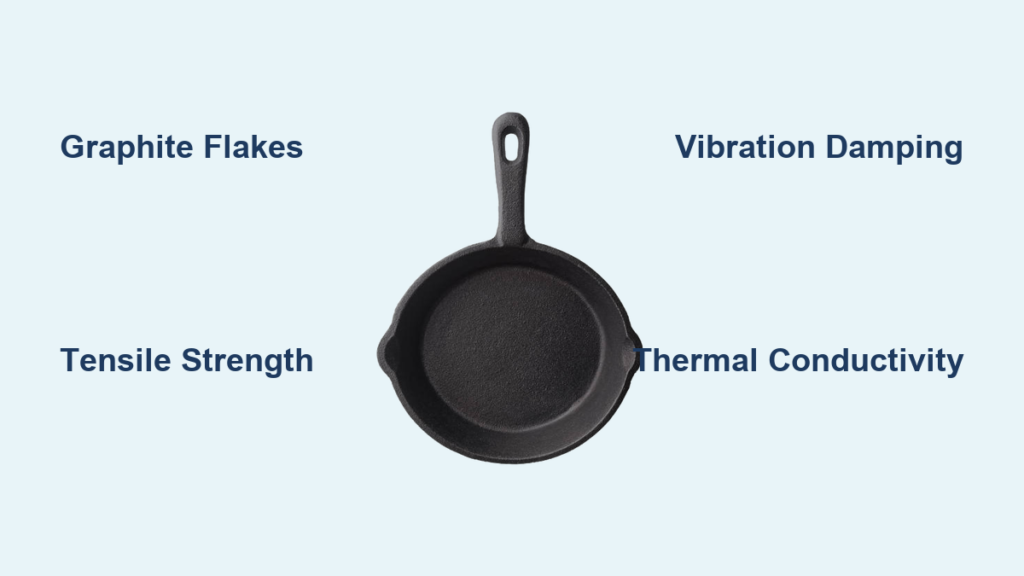
When your machine tool foundation vibrates during precision operations or your automotive component fails under unexpected stress, understanding grey cast iron material properties becomes critical for solving real-world engineering challenges. This versatile ferrous alloy represents the most widely used cast material globally, chosen for its unique balance of cost-effectiveness, vibration damping, and thermal characteristics. Grey cast iron’s distinctive gray fracture surface—created by embedded graphite flakes—directly determines its performance across applications from engine blocks to cookware. This guide delivers precise technical insights into grey cast iron material properties that engineers and manufacturers need for optimal material selection and component design.
The graphite-flake microstructure defines every aspect of grey cast iron’s behavior, creating both remarkable advantages and specific limitations. These flakes act as internal stress concentrators that initiate fracture under tension while simultaneously providing exceptional vibration damping and machinability. Unlike ductile materials that deform before failing, grey cast iron fractures with virtually no plastic deformation, making tensile strength its primary mechanical constraint. By understanding these fundamental grey cast iron material properties, you can determine whether this cost-effective material suits your specific application requirements or if alternatives like ductile iron would be more appropriate.
How Chemical Composition Determines Grey Cast Iron Performance
Your grey cast iron casting’s success hinges on maintaining precise chemical composition during melting. Carbon content must stay between 2.5-4.0% by weight to provide sufficient raw material for graphite formation, while silicon content of 1-3% actively promotes graphite precipitation instead of iron carbide formation. These elements work together to ensure graphite constitutes 6-10% of the total material volume—creating the signature grey appearance when fractured.
Silicon plays the decisive role in determining whether you get usable grey iron or brittle white iron. At concentrations approaching 3%, silicon ensures virtually all carbon exists as graphite rather than iron carbide. This graphitization process directly controls your casting’s final properties:
- Lower silicon (1-1.5%): Produces harder material with reduced machinability
- Medium silicon (1.5-2.5%): Balances strength and vibration damping
- Higher silicon (2.5-3.0%): Maximizes damping capacity but reduces strength
Cooling rate significantly impacts your final microstructure. Moderate cooling produces a pearlitic matrix for higher strength, while rapid cooling creates a ferritic structure with better machinability but reduced hardness. Achieving a fully ferritic matrix requires deliberate annealing after casting—something many manufacturers overlook when troubleshooting unexpected performance issues.
Why Graphite Flakes Make Grey Cast Iron Unique
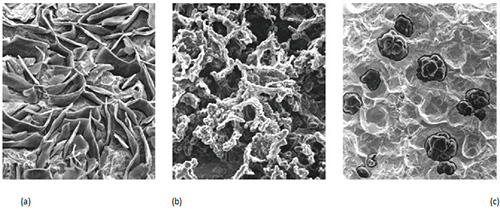
The three-dimensional graphite flake structure fundamentally governs how grey cast iron responds to mechanical loading. These flakes create stress concentration points at their tips—acting as pre-existing notches that initiate fracture under tensile forces. This explains why grey cast iron exhibits such low tensile strength compared to its impressive compressive strength (typically 3-4 times higher).
You’ll see these graphite flakes as dark, interconnected regions when examining a polished cross-section under magnification. Despite seeming like structural weaknesses, they provide critical advantages:
- Machinability: Graphite fractures along flake boundaries, breaking chips into small segments that clear easily from cutting zones
- Lubrication: Released graphite particles reduce friction between tool and workpiece, extending tool life
- Vibration damping: Flake-matrix interfaces convert mechanical energy into heat, suppressing resonant vibrations
This combination makes grey cast iron the preferred material for machine tool bases where vibration control directly impacts machining accuracy—something you’ll notice immediately when comparing equipment mounted on alternative materials.
Decoding ASTM Classifications for Practical Applications

ASTM A48 classification directly correlates with grey cast iron material properties you’ll encounter in engineering specifications. Each class number represents minimum tensile strength in thousands of pounds per square inch, guiding your material selection for specific applications:
Class 20: Minimum 20,000 psi tensile strength (140 MPa)
Ideal for vibration-sensitive applications where damping matters more than strength
Class 30: Minimum 31,000 psi tensile strength
Balances machinability with moderate strength for general-purpose components
Class 40: Minimum 40,000 psi tensile strength
Most common grade for automotive engine blocks requiring strength and wear resistance
Class 60: Minimum 62,500 psi tensile strength
High-strength applications requiring careful composition control and often alloy additions
Higher classes like 80 offer impressive numbers but extreme brittleness that limits practical use. When selecting grey cast iron material properties for your application, remember that compressive strength consistently exceeds tensile strength by 3-4x—making this material perfect for pump housings, valve bodies, and other primarily compressive loading scenarios.
Thermal Properties That Make Grey Cast Iron Irreplaceable
Grey cast iron’s thermal characteristics outperform steel in critical applications where heat management matters. With thermal conductivity ranging from 55-75 W/m-K—significantly higher than steel—you get superior heat dissipation in components like brake rotors and engine blocks. This prevents localized hot spots that could cause thermal distortion or material degradation during operation.
Specific heat capacity between 460-500 J/kg-K provides substantial thermal mass, explaining why cast iron cookware maintains consistent temperatures even when adding cold food. The combination of high conductivity and high thermal mass creates a unique thermal profile that’s difficult to replicate with alternative materials.
When designing with grey cast iron material properties, pay attention to thermal expansion characteristics (10-13 × 10⁻⁶/K). This expansion behavior influences joint design and tolerance allocation in assemblies experiencing temperature fluctuations—something many engineers overlook until components bind or develop leaks during thermal cycling.
Critical Advantages You Can’t Ignore (and Limitations to Avoid)
Grey cast iron delivers unmatched value when its specific grey cast iron material properties align with application requirements. The machinability advantage alone can reduce manufacturing costs by 30-50% compared to steel components—graphite’s self-breaking chip formation and lubrication effects significantly extend tool life while allowing higher cutting speeds.
Your most significant limitation comes from the graphite structure itself: virtually zero ductility and poor impact resistance. If your component faces sudden loads or impact events, grey cast iron will likely fail catastrophically. Additionally, you cannot plastically form grey cast iron through forging, extrusion, or rolling—even at elevated temperatures—restricting production to casting processes only.
Before selecting grey cast iron material properties for your application, verify these critical factors:
– Will the component experience primarily compressive loading? (Good)
– Is vibration damping essential for performance? (Excellent)
– Does the application require ductility or impact resistance? (Poor)
– Will thermal cycling occur? (Manageable with proper design)
Real-World Applications Where Grey Cast Iron Excels
Automotive engine blocks represent the classic application where grey cast iron material properties deliver unmatched performance. The vibration damping characteristics reduce engine noise and improve NVH (noise, vibration, harshness) performance—something drivers notice immediately in smoother operation. Cylinder liners benefit from grey cast iron’s natural lubricity and scuff resistance, providing exceptional wear characteristics without expensive coatings.
Disc brake rotors exploit two critical grey cast iron properties simultaneously: high thermal conductivity for heat dissipation and exceptional damping capacity for noise reduction. While railway applications have shifted toward quieter alternatives due to noise regulations, automotive disc brakes continue leveraging these advantages effectively.
Machine tool bases remain perhaps the most compelling application where grey cast iron material properties prove irreplaceable. The exceptional damping capacity absorbs cutting forces and prevents resonant vibrations that would degrade machining accuracy—something you’ll measure directly in improved surface finishes and dimensional consistency on precision components.
Understanding grey cast iron material properties enables smarter engineering decisions that balance performance, cost, and manufacturability. When your application requires exceptional vibration damping, thermal management, and cost-effective production of complex geometries, grey cast iron remains unmatched despite its limitations in tensile strength and ductility. By matching the specific ASTM classification to your performance requirements and designing around the material’s inherent constraints, you can leverage this versatile alloy for optimal component performance. For applications where impact resistance or ductility matters most, consider alternative materials—but when your priorities align with grey cast iron’s unique strengths, no substitute delivers comparable value.