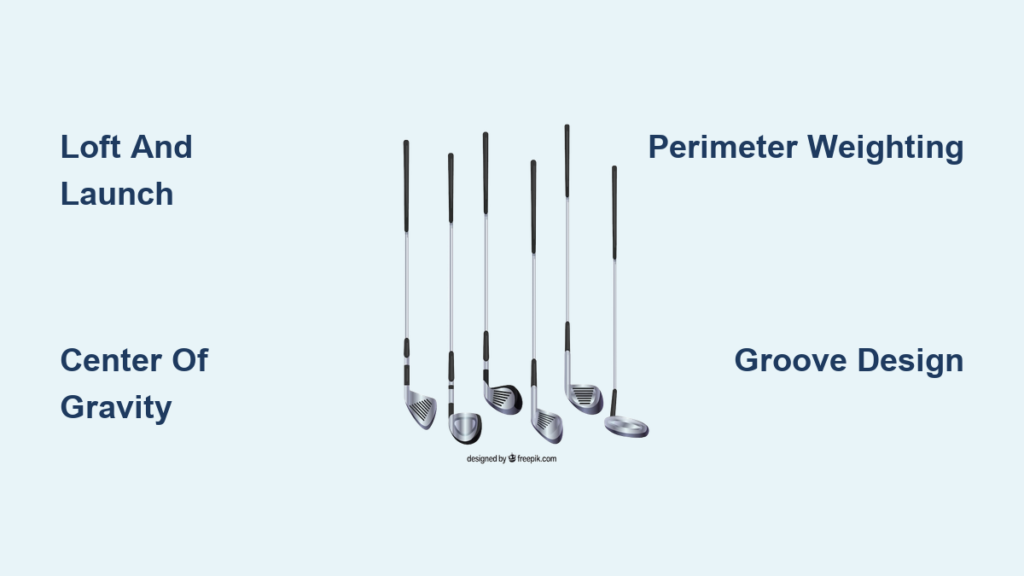
You’ve probably wondered why your 7-iron sends the ball soaring higher than your dad’s 7-iron did 20 years ago, even though you swing with less power. The answer lies in the remarkable engineering packed into modern golf irons. From the moment you strike the ball to the instant it lands softly on the green, a complex interplay of physics determines whether your iron shot finds the target or flies off course. Understanding how golf irons work transforms you from a casual player who just swings at the ball into an informed golfer who can select the right clubs and execute better shots with confidence.
This guide reveals the hidden science behind iron performance, explaining how loft, center of gravity, groove technology, and construction methods directly influence your ball flight. By the end, you’ll know exactly why certain irons work better for your game and how to leverage this knowledge to improve your iron play immediately.
Why Your 9-Iron Launches Higher Than a 1990s 7-Iron
Modern irons have undergone significant de-lofting compared to designs from previous decades. Today’s 9-iron typically carries the same loft as a 7-iron from the 1990s—a difference of about four degrees. You might assume this reduction would make the ball fly lower, but manufacturers counteract this by repositioning weight low in the clubhead. This strategic mass placement effectively lowers the center of gravity, allowing the ball to launch higher despite the reduced face angle.
The typical loft progression in a modern cavity-back iron set follows a precise pattern: 14° for the 1-iron, 17° for the 2-iron, 20° for the 3-iron, 23° for the 4-iron, 26° for the 5-iron, 29° for the 6-iron, 33° for the 7-iron, 37° for the 8-iron, and 41° for the 9-iron. This systematic approach lets you predictably control distance by selecting the appropriate loft for each shot.
How Modern De-Lofting Tricks Your Ball into Higher Flight
The secret behind modern irons’ ability to launch high despite reduced loft lies in their center of gravity positioning. When the CG sits lower in the clubhead, positioned beneath the ball at impact, the clubhead rotates more effectively upward through the impact zone. This physics principle enables manufacturers to reduce loft while maintaining or improving playability—a game-changer for golfers seeking distance without sacrificing control.
The Critical Role of Low Center of Gravity in Launch Angles
A lower CG doesn’t just help launch the ball higher—it also makes your irons more forgiving on slightly fat or thin contacts. When you catch the ball just slightly above or below the sweet spot, the low CG minimizes the negative effects on launch angle. This engineering innovation explains why average golfers can now consistently get the ball airborne with shorter irons that were once considered difficult to hit.
How Perimeter Weighting Makes Your Mishits Less Punishing
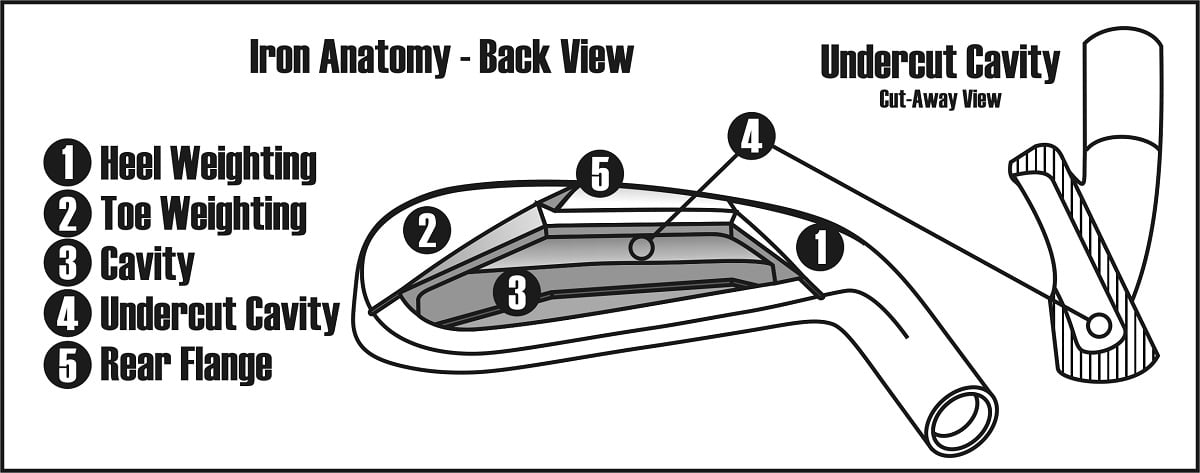
The moment you strike the ball off-center, physics takes over. Traditional muscle-back irons twist dramatically on mishits, sending your ball veering off target. Modern cavity-back irons solve this problem through perimeter weighting—redistributing metal from the center of the clubhead to the toe and heel edges. This strategic weight placement creates a larger sweet spot that maintains consistent distance and direction even when you don’t catch the ball perfectly.
Why Cavity-Back Irons Resist Twisting on Off-Center Hits
Moment of inertia (MOI) measures a clubhead’s resistance to twisting when you strike the ball away from the sweet spot. Higher MOI means more consistent results on imperfect contact. When manufacturers remove metal from the back center of the clubhead to create the cavity, then reposition that mass toward the perimeter, they dramatically increase MOI. The result? A club that forgives the inevitable inconsistencies in your swing.
The Moment of Inertia Secret Behind Forgiving Irons
For the average golfer who makes solid contact just 70% of the time, high-MOI irons can be the difference between penalty strokes and pars. When you hit the ball on the toe with a traditional blade, the clubface opens dramatically, sending your shot right. With a high-MOI cavity back, the same mishit produces only a slight push—keeping the ball in play where a blade would have found the hazard.
Groove Physics: Why Your Irons Generate More Spin from the Rough

Those parallel channels scored across your iron’s face serve a critical function that directly affects your control. Grooves channel grass, dirt, and moisture away from the ball at impact, enabling cleaner contact between clubface and ball. Without them, debris would sit between the impact surfaces, reducing friction and robbing you of spin and control—especially from the rough.
How Grooves Channel Debris for Cleaner Ball Contact
Deeper grooves enhance this debris-evacuating capability, allowing more effective grass dispersion on shots from the rough. This directly translates to higher spin rates and greater stopping power on the green. If you’ve ever noticed your wedges spin more from the fairway than your long irons, it’s because the wedges have sharper, deeper grooves that engage the ball more effectively.
Why USGA’s 2010 Groove Restrictions Changed Short Game Strategy
Regulatory bodies implemented groove restrictions beginning in 2010, limiting groove depth and cut angle. These rules particularly penalize shots from longer grass, where the new, shallower grooves cannot evacuate debris as effectively as older designs. The regulations effectively emphasize the premium on hitting the fairway, as shots from the rough lose more distance and spin than they did under pre-2010 equipment standards.
Forged vs. Cast Irons: Which Construction Method Matches Your Game
The manufacturing process fundamentally shapes an iron’s characteristics and feel. Forging involves shaping heated metal through hammering or pressing, producing clubheads with a softer, more uniform grain structure. This construction method creates the classic “blade” feel that skilled players describe as smooth, responsive feedback transmitted through the hands at impact.
Why Forged Irons Provide Superior Feedback at Impact
Forged clubheads offer superior feedback because the softer metal transmits vibrations more effectively when you strike the ball. This precise sensory information helps skilled players diagnose their contact quality instantly—whether they caught it on the toe, heel, or sweet spot. Forged irons also permit easier customization; club fitters can readily bend them to adjust loft and lie to match your specific swing characteristics.
How Casting Enables Extreme Perimeter Weighting
Investment casting revolutionized iron manufacturing by enabling mass production with consistent properties and complex geometries. This process creates a mold around a wax pattern, fills it with molten metal, and produces a clubhead with harder metal than forged equivalents. The harder material permits thinner clubface surfaces without sacrificing durability, while the process enables precise weight placement impossible with forging—making modern cavity-back designs possible.
Muscle-Back vs. Cavity-Back Irons: What Pros Know That You Don’t

Muscle-back irons represent the traditional blade design, featuring solid metal heads that distribute weight more evenly around the clubhead with concentration along the sole. This construction produces a higher center of gravity and lower MOI compared to cavity-back designs, resulting in a smaller sweet spot and less forgiveness on mishits. The compact profile and minimal offset appeal to skilled players who value workability—the ability to intentionally shape shots.
Why Blades Give Skilled Players Better Shot Control
The smaller sweet spot of muscle-back irons demands consistent, precise contact to produce accurate results. While this makes them difficult for beginners, skilled players leverage this characteristic to execute precise shot-making including fades and draws. The immediate feedback from blades helps accomplished golfers make micro-adjustments to their swing, enabling them to shape shots intentionally around obstacles.
How Game-Improvement Irons Help Average Golfers Lower Scores
Cavity-back irons derive their name from the cavity created when metal is removed from the back center and redistributed to the perimeter. This weight relocation lowers the CG while increasing MOI, creating a substantially larger sweet spot that maintains consistent distance and direction on slight mishits. Most average golfers benefit significantly from this design, as it helps them achieve better results despite less consistent ball-striking.
Iron Components That Directly Impact Your Shot Consistency
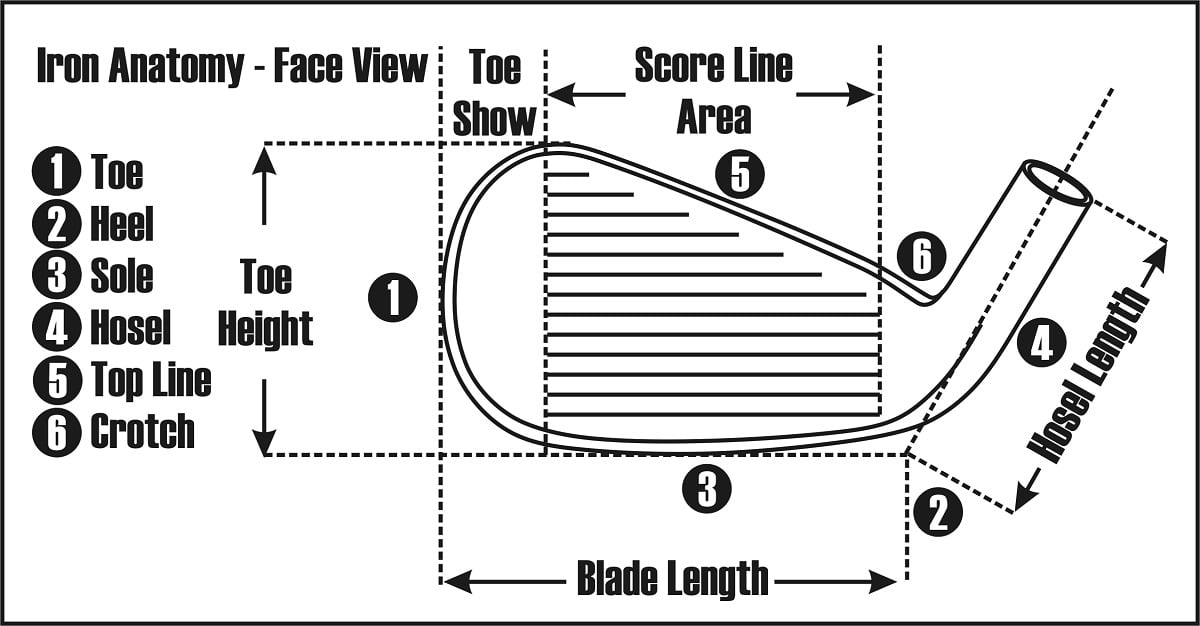
Understanding iron anatomy helps you appreciate how the various parts work together to produce effective shots. The clubhead comprises the primary striking surface and its supporting structure, with modern designs utilizing various steel alloys optimized for specific performance characteristics. The striking face features the grooves that affect spin, while the face angle influences initial shot direction.
Why Steel Shafts Dominate Iron Construction for Accuracy
Steel shafts dominate iron construction due to their lower torque, which reduces clubhead twisting during the swing and improves accuracy. The shaft’s flex must match your swing speed and tempo; improper flex causes inconsistent shots and reduced distance. While graphite shafts appear in some iron sets (particularly longer irons), steel remains standard for wedges where precision outweighs distance considerations.
How Hosel Design Affects Your Ability to Square the Face
The hosel forms the curved connection between clubhead and shaft, with modern designs increasingly featuring offset geometries that position the hosel lower and farther from the hitting area. Combined with perimeter weighting, this offset promotes the lowest possible center of gravity. However, the hosel’s position creates potential for “shanking”—shots that contact the hosel rather than the clubface, sending the ball sharply sideways.
How to Select Irons Based on Your Actual Skill Level
Choosing irons that match your skill level maximizes your performance and enjoyment of the game. Game-improvement irons, featuring extreme perimeter weighting and very wide soles, help novice and casual amateur players launch the ball more consistently and achieve straighter shots despite less consistent ball-striking. These designs reduce errant shots and penalty strokes, ultimately improving scores by promoting more contact near the sweet spot.
Game-Improvement Irons: When They Help (and Hurt) Your Game
However, the forgiving characteristics of game-improvement irons can impede skilled golfers attempting to work the ball intentionally. The clubs resist the face rotation and swing path modifications required to shape shots, frustrating precise shot placement. Additionally, their increased mass and lower center of gravity may conflict with faster swings, potentially reducing clubhead speed and producing excessive backspin.
Player’s Irons: The Balance Between Forgiveness and Workability
Clubs designed for skilled amateurs and professionals incorporate moderate perimeter weighting while concentrating more mass near the center and higher in the head. Reduced overall mass increases clubhead speed and allows greater swing variation for distance control. This balanced approach enables skilled players to work the ball while benefiting from some forgiveness—a compromise between pure blades and maximally forgiving game-improvement designs.
Understanding how golf irons work empowers you to make smarter equipment choices and execute better shots. The next time you address the ball with an iron, remember the remarkable physics happening at impact—the interplay of loft, center of gravity, and groove technology that transforms your swing into a controlled trajectory toward the target. When selecting new irons, prioritize models that match your actual skill level rather than what the pros use, and consider professional fitting to optimize lie angle, shaft flex, and grip size for your unique swing. With the right irons properly fitted to your game, you’ll transform from guessing at your distances to confidently executing precise iron shots that find the green consistently.