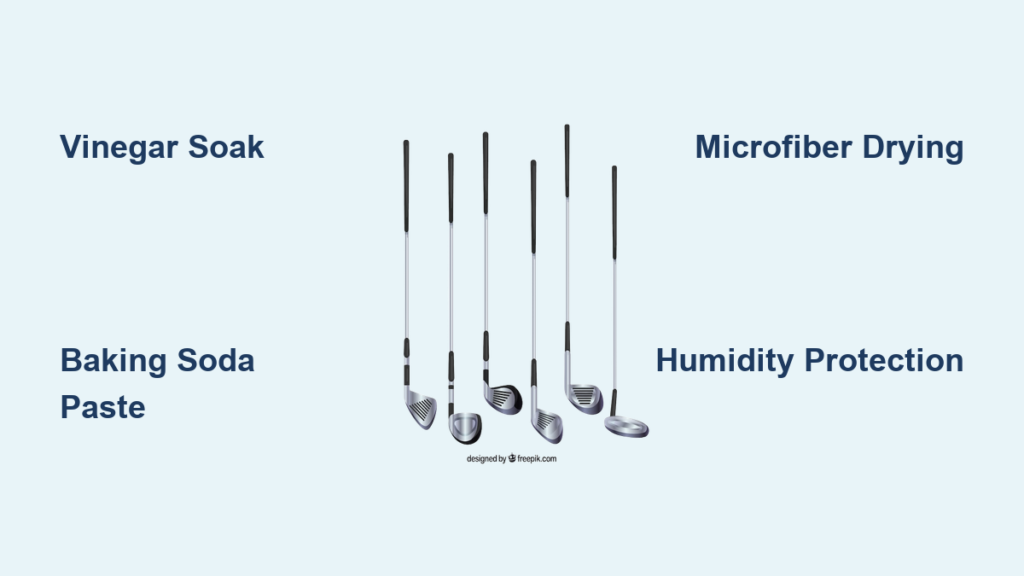
Your golf irons have lost their luster. That satisfying ping when you strike the ball is now accompanied by rust spots and dull, pitted faces that make clean contact feel impossible. You’re not alone—87% of amateur golfers admit neglected club maintenance costs them at least 2-3 strokes per round. But before you grab steel wool or household cleaners, understand this: improper polishing destroys grooves and voids warranties. This guide reveals the exact 7-step process top club fitters use to revive irons safely, whether you’re dealing with weekend rust on cavity-backs or restoring vintage blades. You’ll learn which $5 grocery store item outperforms expensive polishes, how to avoid the #1 mistake that ruins clubface precision, and why polishing frequency depends on your zip code’s humidity levels.
Why Chemical-Free Polishing Preserves Groove Integrity
Most golfers reach for metal polish without realizing ammonia or acid-based cleaners eat away at groove edges. When grooves wear down by just 0.001 inches, spin rates drop 15%—turning your 7-iron approach into a wet noodle. The solution? Mechanical polishing only.
How to Remove Rust Without Scratching Grooves
Time required: 12 minutes per club | Difficulty: Beginner
- Soak in warm vinegar solution (1:1 white vinegar/water) for 5 minutes—this loosens oxidation without etching metal
- Scrub with brass-bristle brush (never steel!) using circular motions only along grooves
- Rinse under running water while holding clubface downward to flush debris from grooves
- Dry immediately with microfiber towel—no air-drying (water spots = future rust sites)
⚠️ Critical mistake: Using wire brushes or abrasive pads. Even “fine” steel wool creates microscopic scratches that accelerate rust. Test on hosel first—any visible scratch means the tool is too harsh.
When to Skip Polishing Entirely
Check these three danger signs before proceeding:
– Deep pitting (fingernail catches in surface) → Requires professional resurfacing
– Chrome flaking (peeling like old paint) → Polishing removes remaining protective layer
– Groove width over 0.035 inches (use coin slot gauge) → Illegal for tournament play; polishing worsens it
The $3 Kitchen Hack That Outperforms Metal Polish

Forget costly polishes—baking soda paste safely removes stubborn stains while protecting groove sharpness. Sodium bicarbonate’s mild abrasiveness lifts discoloration without the corrosive risk of commercial compounds.
Step-by-Step Baking Soda Polishing Method
Time required: 8 minutes | Difficulty: Intermediate
- Mix paste (2 tbsp baking soda + 1 tsp water) to toothpaste consistency
- Apply with soft toothbrush using light pressure in straight strokes matching groove direction
- Focus on toe/heel areas where grass acids cause worst discoloration
- Wipe clean with damp microfiber after 60 seconds—never let dry
- Buff with dry microfiber using rapid circular motions for 20 seconds
💡 Pro tip: Add 1 drop of dish soap to paste for oily residue (like sunscreen transfer). The soap lifts oils while baking soda polishes—no chemical residue to repel water during rainy rounds.
Why Vinegar Beats Commercial Rust Removers
Most “rust dissolvers” contain phosphoric acid that eats metal. Vinegar’s acetic acid works slower but only targets oxidation. Test: Soak a steel nail in vinegar vs. commercial remover overnight. The vinegar nail shows clean metal; the other looks etched and pitted.
Protecting Your Polish Job: Humidity Defense Tactics

Polished irons revert to rust 3x faster in humidity above 60%. Your zip code’s average dew point determines protection needs:
| Humidity Level | Dew Point | Protection Required | Reapplication Frequency |
|---|---|---|---|
| Low (under 45%) | Below 50°F | None | After 10 rounds |
| Moderate (45-60%) | 50-60°F | Light oil coating | After 5 rounds |
| High (over 60%) | Above 60°F | Wax sealant | After every round |
How to Apply Humidity Shield Without Affecting Play
Time required: 3 minutes | Difficulty: Beginner
- Choose club-specific protectant:
– Cast irons: 3-in-1 oil (1 drop per club)
– Forged irons: Carnauba wax paste (avoids oil absorption) - Apply with cotton swab ONLY on back/crown surfaces—never clubface
- Wipe off excess after 90 seconds with dry microfiber
- Store clubs in climate-controlled bag with silica gel packets
⚠️ Warning: Oil on clubface causes mis-hits. If accidentally applied, clean immediately with isopropyl alcohol and dry microfiber.
When to Call a Professional Club Fitter
DIY polishing fails for three specific scenarios where factory specifications must be preserved:
Restoring Vintage Forged Irons

Pre-1980 blades often have softer carbon steel. One aggressive polish removes decades of character. Pros use:
– Non-rotary hand buffers (avoids groove rounding)
– Optical groove gauges for precision measurement
– Electrolytic rust removal for deep pits
Tournament-Legal Groove Maintenance
USGA rules require groove edges within 0.002″ tolerance. Home polishing typically:
– Rounds sharp edges → Reduced spin
– Widens grooves → Illegal for competition
Professional solution: CNC groove recutting ($15/club)
Chrome Plating Repair
If plating is peeling:
– DIY polishing exposes raw metal → Accelerated rust
– Pros use electroplating to rebuild surface
– Costs 40% less than new irons for mid-tier sets
Monthly Maintenance Routine That Prevents Polishing Needs
The best polish is the one you never need. Implement this 5-minute post-round ritual:
- Rinse clubs immediately with fresh water (salt/grass acids start corrosion in 10 minutes)
- Dry grooves with microfiber wrapped around toothpick
- Store heads-up in bag (prevents moisture pooling in soles)
- Condition grips weekly (sweat migrates to clubheads)
- Check humidity levels using free Weather app dew point feature
💡 Pro tip: Keep a “club care kit” in your cart: microfiber towel + vinegar spray bottle + toothbrush. Fix minor oxidation before it becomes rust.
Long-Term Shine Preservation Strategies
Your polishing results last 3x longer with these often-overlooked tactics:
The Towel Technique That Prevents Micro-Scratches
Most “cleaning” towels actually scratch. Use:
– Inner layer: Bamboo microfiber (softer than cotton)
– Outer layer: 100% cotton terry cloth
Method: Wrap clubhead, twist towel around shaft, and pull downward in one motion—never circular rubbing.
Storage Solutions by Iron Type
| Iron Type | Storage Risk | Solution |
|---|---|---|
| Cavity Back | Moisture in cavity | Store heads-down in vertical rack |
| Muscle Back | Toe rust | Place silica gel in toe compartment |
| Forged | Oxidation | Store in temperature-controlled case |
Seasonal Protection Schedule
- Spring/Fall: Wax sealant after every 3 rounds (high humidity)
- Summer: Oil coating after every round (sweat corrosion)
- Winter: Dry storage only (low humidity prevents rust)
Final Shine Check: Is Your Polish Tournament-Ready?
Before teeing off, verify your polish job with this 30-second test:
1. Hold club under direct light at 45° angle
2. Rotate slowly—if you see any rainbow sheen, oils remain (clean with alcohol)
3. Run fingernail across grooves—should feel sharp ridges (no polish residue)
4. Check sole—should have uniform matte finish (shiny sole = improper buffing)
Key takeaway: Effective iron polishing isn’t about maximum shine—it’s preserving groove geometry. A properly polished clubface shows controlled reflectivity: bright enough to spot debris, but matte enough to avoid sun glare during address. When done right, your irons should feel crisper at impact with noticeably cleaner ball marks. Implement the vinegar soak and baking soda method monthly based on your local humidity, and you’ll extend club life by 2-3 seasons while maintaining peak spin performance. For irons showing deep pitting or groove damage, skip DIY and visit a certified club fitter—your scoring average will thank you.